Home
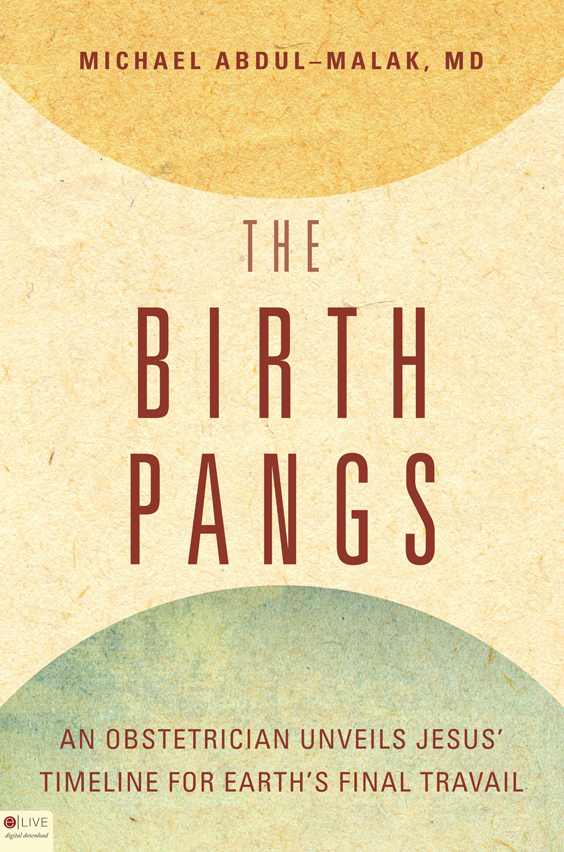
In The Birth Pangs, Dr. Abdul–Malak harnesses his experience with thousands of labors and a lifelong commitment to an in–depth study of end–times prophecy to take us on a fascinating journey through the most confusing and controversial issue in the Bible, Christ’s Second Coming. Utilizing the “birth pangs” metaphor—used by Jesus himself—and real examples from his years of experience as an OB–GYN, the author skillfully portrays the sequence of events that will lead to the Second Coming in a very logical easy to understand format, and gives us valuable practical advice on how to be prepared for the perilous times ahead.
Unlike many books on the Second Coming, The Birth Pangs explores prophecy starting with only the Bible and no preconceived ideas. When it comes to controversial issues, such as the timing of the rapture, the author challenges commonly held views in an objective and unbiased manner, subjecting them to rigorous examination in light of the Scriptures, letting you be the final judge. Like the labor process, the author believes that end–time prophecy should be simple enough for every Christian to understand.
Excerpts
From Chapter 2
The fact that God placed so much emphasis on prophecy in the Scripture is a clear indication that prophecy is an integral part of what God is trying to relay to us as his children. Consequently, one would expect that the study of prophecy would be an essential part of our day-to-day study of the Bible. The sad reality is that many Christians are hardly giving any time to the study of this important topic. The many diverse schools of interpretation make the average Christian feel overwhelmed and confused as to which interpretation is correct. Instead of helping to alleviate that state of hopelessness, the abundant literature on prophecy adds to the confusion by emphasizing one theory or the other and giving little or no consideration for the opposing theories. These factors and others have led many sincere Christians to conclude that it is impossible to have a correct interpretation of prophecy. Consequently, they decided to completely neglect the study of that important part of God’s message for us. There is no way that this neglect will be without grave consequences.
Let us assume you are a medical student studying to be a doctor and you decided during the course of your studies to forego the study of a certain category of diseases or even a single disease just because it was too controversial, too confusing, or hard to understand. One day, you may have a patient with that disease, and you will not know how to diagnose or treat it. As a result this person could die. That’s how it is with the second coming. You can’t ignore it just because it is laden with controversy or because you think it is too difficult to understand. God didn’t place prophecy in his book in vain. Like every other topic in his word, God put prophecy there because we need it. Just as in the example of the medical student above, studying the second coming is not a luxury that is only for a small elite group, but a necessity for every Christian. The only difference between your situation as a Christian who neglects to study certain parts of God’s word and the situation of that medical student is that a physician might go through his entire career and never get a patient with that particular disease he neglected to study. Jesus however is definitely coming again, and you can’t afford to take the chance of being unprepared for his coming by neglecting to study what he explicitly told you about it in his word.
From Chapter 8
Labor is a process that is familiar to people everywhere. Whether the birth happens in the heart of a remote African jungle or in the most modern hospital in America, it is always the same. Labor also transcends generational barriers. It has been happening, and will continue to happen the same way from the time when Adam and Eve had their first child until the last human being is born. Jesus’ use of this analogy has convinced me that he did not intend the understanding of prophecy to be a gift imparted to a select few authorities in the field. He wanted every Christian to understand prophecy. That discovery was the main motivation for me to persevere in studying prophecy, and to eventually write this book.